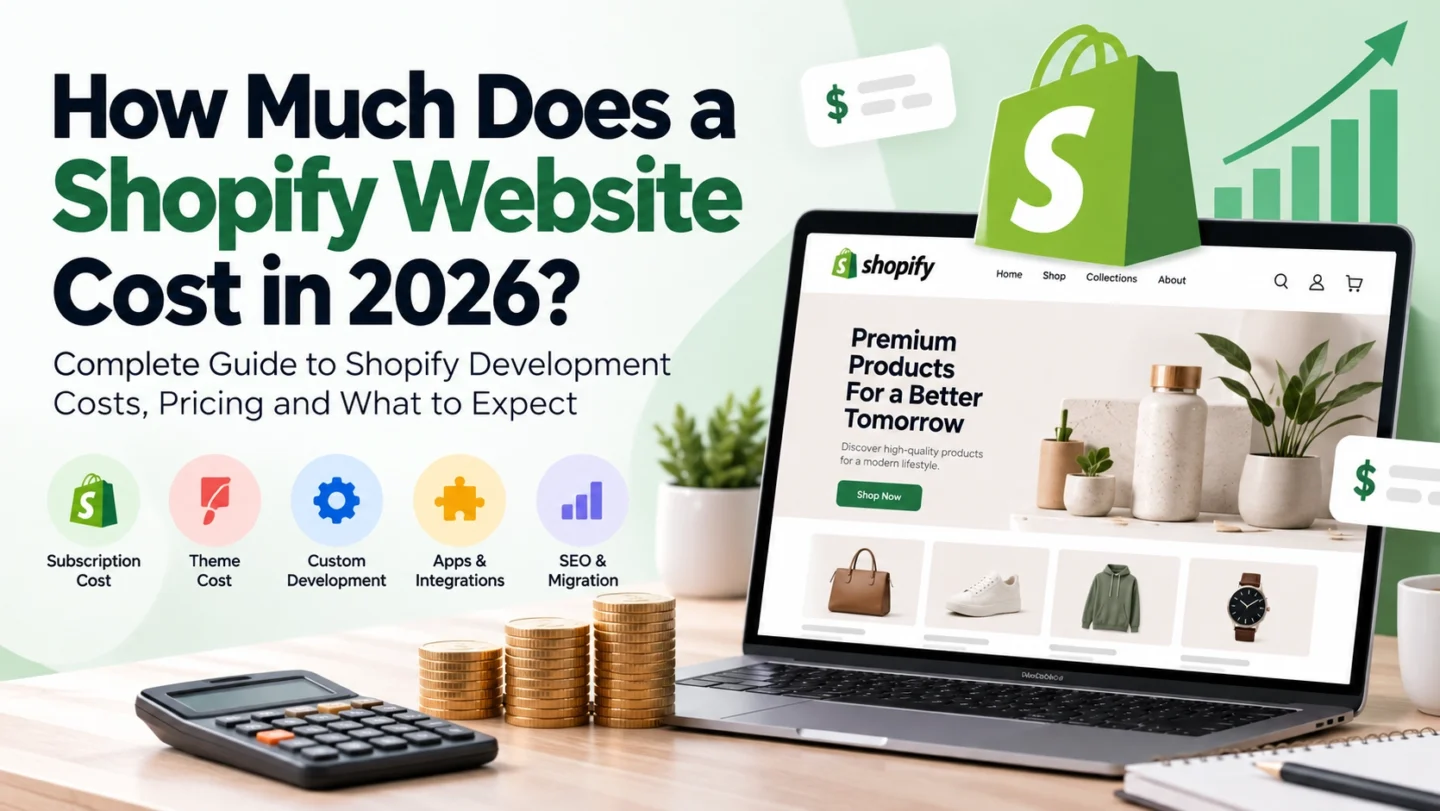
How Much Does a Shopify Website Cost in 2026?
If you are planning to start an online store, one of the first questions you may have is: how much does a Shopify website cost?
There is no single price for Shopify website development. The final cost depends on your store size, design requirements, number of products, custom features, integrations and whether you use a ready-made theme or build a custom Shopify store.
In this guide, we explain the major costs involved so you can plan your Shopify project more effectively.
What Determines the Cost of a Shopify Website?
A simple Shopify store and a completely custom ecommerce website require very different levels of development.
The main factors that affect Shopify development cost include:
- Store design and UI/UX requirements
- Number of products and collections
- Custom Shopify theme development
- Third-party app integrations
- Payment gateway setup
- Shipping configuration
- Custom functionality
- Product filtering and search
- SEO setup
- Migration from another ecommerce platform
1. Shopify Subscription Cost
Shopify itself requires a subscription. Different plans provide different features for businesses at different stages.
Your Shopify subscription is separate from the amount you pay a designer or developer to build and customize your store.
Before choosing a plan, consider your expected sales volume, staff requirements, reporting needs and ecommerce features.
2. Shopify Theme Cost
You can start with either a free Shopify theme or a premium theme.
A ready-made theme can reduce initial development time, but it may not provide the exact design or functionality your business requires.
Businesses that want a distinctive ecommerce experience may choose custom Shopify theme development.
A custom theme gives you more control over:
- Brand identity
- Homepage layout
- Product pages
- Collection pages
- Navigation
- Mobile experience
- Conversion-focused sections
3. Custom Shopify Development
Development costs increase when your store requires functionality beyond the standard Shopify setup.
This could include:
- Advanced product filters
- Custom product options
- Variant selectors
- Product comparison
- Custom cart functionality
- API integrations
- Subscription functionality
- Wholesale or B2B features
- Custom sections
- Third-party system integrations
The more custom functionality your business requires, the more development and testing will be involved.
4. Shopify Apps
Apps can extend the functionality of your Shopify store without requiring every feature to be developed from scratch.
For example, businesses commonly use apps for reviews, email marketing, subscriptions, search, product filters, upselling and shipping.
However, installing too many apps can increase monthly costs and may introduce unnecessary scripts or functionality.
A good Shopify development approach is to use apps where they provide real value and use custom development when it makes more sense.
5. Shopify SEO Setup
A beautiful ecommerce website is not enough if potential customers cannot discover it.
Your initial Shopify SEO setup should consider:
- SEO-friendly site structure
- Page titles
- Meta descriptions
- Product URLs
- Collection structure
- Image ALT text
- Internal linking
- Structured data
- Page speed
- Mobile usability
SEO should ideally be considered while building the website rather than added only after launch.
6. Ecommerce Migration Cost
If you already have a store on WooCommerce, Magento, Wix or another platform, migration adds another layer to the project.
Migration may involve transferring:
- Products
- Categories or collections
- Customers
- Orders
- Images
- Pages
- Blog content
- SEO metadata
Existing URLs also need careful handling. Incorrect migrations can result in broken links and lost search visibility.
Should You Use a Template or Custom Shopify Design?
A template-based store can work well for a new business with straightforward requirements and a limited budget.
Custom Shopify development makes more sense when your business needs a distinctive brand experience, unique functionality or a store designed around a specific customer journey.
Is Shopify Worth the Investment?
Shopify can be a strong choice for businesses that want a hosted ecommerce platform without managing much of the underlying server infrastructure themselves.
The right question is therefore not simply “How much does Shopify cost?”
Consider what your store needs to accomplish, how easily customers can find products, how well it works on mobile and how efficiently your team can manage it after launch.
Need a Shopify Website for Your Business?
Webinhance provides Shopify design and development services for businesses that need new ecommerce stores, redesigns, custom functionality and platform migrations.
Explore our Shopify development services to learn how we can help you build a fast, scalable and user-friendly ecommerce store.
Frequently Asked Questions
How much does it cost to build a Shopify website?
The cost depends on the design, number of products, integrations and custom functionality required. A standard theme setup typically requires less development than a fully custom Shopify store.
Can I build a Shopify website myself?
Yes. Shopify allows business owners to create stores using themes and apps. Professional development becomes useful when you need custom design, advanced functionality, integrations or technical optimization.
Do I have to pay monthly for Shopify?
Yes. Shopify is a subscription-based ecommerce platform. Your platform subscription and any paid apps are separate from website design and development costs.
How long does it take to build a Shopify store?
The timeline depends on the scope. A straightforward store can be completed much faster than a custom ecommerce project involving complex integrations, large product catalogs or migration.